


Answer Engine Optimization (AEO): The Business Owner’s Guide to Optimizing for Direct Answers
Ever asked Siri or Alexa a question and instantly got a spoken answer instead of a list of links? Answer Engine Optimization is the strategy that makes that possible. In today’s search landscape, people want quick, concise answers – and increasingly, search engines and AI assistants want to deliver exactly that. For business owners, this shift presents both a challenge and an opportunity. Embracing Answer Engine Optimization (AEO) can dramatically boost your brand’s visibility by ensuring your content is the one providing those instant answers. In this comprehensive guide, we’ll walk through what AEO is, how it differs from traditional SEO, and actionable strategies to help your business excel in a world of voice search and digital assistants.
We’ll cover everything from AEO vs. SEO comparisons to step-by-step AEO strategies (like using structured data, optimizing snippets, and crafting concise content) that directly answer customer questions. You’ll learn implementation tips, discover useful tools and resources, and even see where infographics can illustrate key points. By the end, you’ll understand why optimizing for answer engines is becoming as essential as traditional SEO – and how to get started with AEO to stay ahead of the competition.
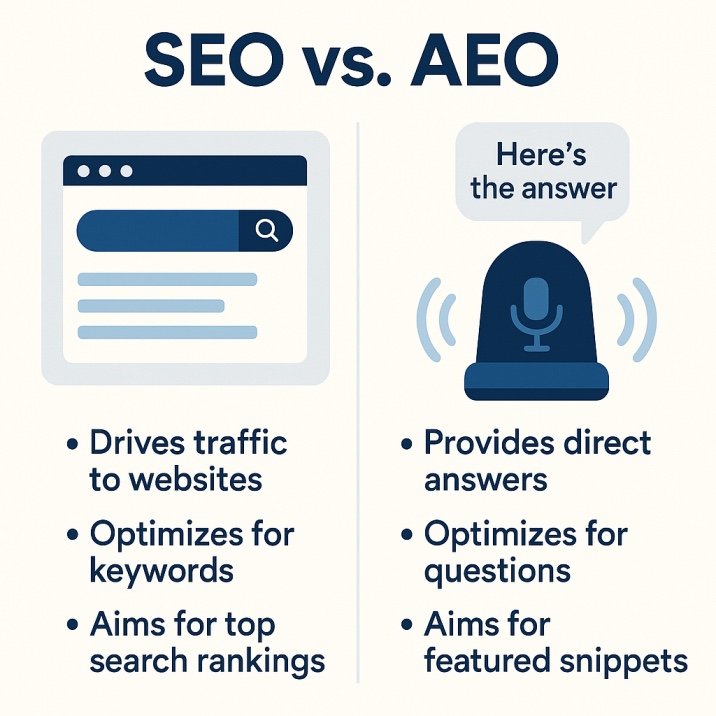
AEO vs. SEO: Understanding the Difference
It’s helpful to first compare Answer Engine Optimization with the traditional Search Engine Optimization you’re already familiar with. Both AEO and SEO aim to make your content more visible and helpful to users, however, they approach this goal in different ways. While SEO focuses on improving a website’s visibility on search engine results pages (SERPs) through keywords, backlinks, and overall site authority, AEO (Answer Engine Optimization) zeroes in on directly answering user queries in the search results themselves. In other words, SEO is about earning a high ranking link, whereas AEO is about earning a featured answer.
What exactly is an “Answer Engine”? It’s essentially any system (like Google’s answer box, Siri, Alexa, or AI chatbots) that can provide a direct answer to a query, rather than just a list of websites. Think of Google’s Featured Snippets, the new AI-generated answers in results, or the responses you hear from a voice assistant – those are all powered by answer engines. As user behavior shifts toward asking questions in natural language (especially via voice), ensuring your content is the one chosen for those answers is the heart of AEO.
To make the differences clearer, here’s a quick comparison of traditional SEO versus AEO:
| Aspect | Traditional SEO 💻 | Answer Engine Optimization (AEO) 🔊 |
| Primary Goal | Improve ranking on SERPs (get on page 1 of Google). | Appear as a direct answer (position 0, featured snippet, or voice answer). |
| Focus | Keywords and relevance of content to search queries. | User questions and intent; providing concise, factual answers. |
| Output for Users | List of ranked links and snippets on a results page. | Single answer or summary (often no click needed) delivered via snippet or voice. |
| Key Strategies | Content optimization, link building, meta tags, internal linking, etc. | Structured data (schema), Q&A formatted content, optimizing for featured snippets, voice-friendly content. |
| Example | Blog post aiming to rank for “best running shoes” keyword. | Q&A section or snippet in a post directly answering “What are the best running shoes for marathons?” |
| Success Metric | High organic traffic, click-through rates from SERPs. | Being selected as the answer (featured snippet selection, voice assistant quoting you). |
| User Engagement | User clicks a link to find the answer on your site. | User often gets answer immediately; if done well, they trust your brand and may still visit for details. |
From the table above, notice that AEO doesn’t replace SEO but rather builds upon it. In fact, some experts consider AEO a specialized subset of SEO. Both require quality content and understanding user intent. However, AEO requires you to format and present that content in a way that answer engines (powered by AI and voice search algorithms) can easily interpret and display. As a business owner, you should continue practicing good SEO fundamentals and add AEO tactics into the mix to capture those valuable “direct answer” spots.
It’s also worth noting the emergence of GEO (Generative Engine Optimization) in discussions. GEO refers to optimizing content for generative AI platforms (like ChatGPT’s answers or Google’s AI-driven Search Generative Experience) – essentially making sure AI bots pick up your content when they formulate answers. GEO can be seen as a subset of AEO focusing on AI chatbots and synthesized answers. For our purposes, we’ll stick to the broader AEO concept, which covers all direct-answer platforms (including voice assistants and on-SERP answer boxes).
Why Answer Engine Optimization Matters in 2025
You might be thinking, “Is AEO really that important for my business?” Absolutely! User behavior is evolving, and so are search technologies. Here are a few reasons why AEO deserves your attention:
- Rise of Voice Search: People are using voice queries more than ever. In fact, 58% of consumers have used voice search to find local business information. This means potential customers might ask their phone or smart speaker “Where’s the best pizza place nearby?” and get an instant spoken answer. If your local business info or content isn’t optimized to be that answer, you miss out. Voice searches tend to be question-based and longer phrased (conversational), exactly what AEO targets.
- AI-Powered Answers are Replacing Clicks: Search engines are increasingly showing direct answers. Google’s featured snippets and AI Overview boxes (a new AI-generated answer summary in the results) often give the user what they need without clicking any link. Gartner predicts that by 2026, traditional search volume could drop by 25%, and organic traffic may decline by up to 50% as users turn to AI-powered tools for answers. That’s a massive shift – but if your content is the one being quoted or cited in those answers, you still gain visibility and credibility, even if the user doesn’t click through immediately.
- Changing Consumer Expectations: Moreover, users love quick, convenient answers. Providing concise and correct information immediately builds trust. If your brand consistently answers customer questions (be it via a snippet, an FAQ, or a voice answer), you become a trusted authority in their eyes. This improved user experiencenot only helps users but also signals to search engines that your content is valuable.
- Competitive Edge: Many businesses are still not fully tuned into AEO. Implementing AEO strategies now can give you a head start. It’s an opportunity to leapfrog competitors in the search results by occupying answer boxes and voice slots that others haven’t optimized for. Early adopters of new optimization tactics often reap outsized benefits. Additionally, being featured as an answer often has a snowball effect – once one answer engine trusts your content, others may follow.
In short, AEO matters because it aligns your content with how people actually ask questions in 2025. Rather than hoping customers sift through a list of links to find you, AEO helps bring your answers to them directly. It’s a powerful way to stay visible in an era of dwindling blue links and growing voice and AI responses.
Answer Engine Optimization to put your content in the Answer Box
Now let’s dive into actionable strategies. The good news is that Answer Engine Optimization isn’t a completely separate discipline from SEO – in fact, many AEO best practices overlap with good SEO and content marketing practices you may already know. The key is to fine-tune your content creation and optimization specifically toward answering questions clearly and concisely. Here are the core strategies to focus on:
1. Research and Target Common Questions
Just as traditional SEO starts with keyword research, Answer Engine Optimization starts with question research. The goal is to find out what questions your target audience is asking related to your industry or products. Start by tapping into tools and techniques to discover frequently asked questions:
- Use Google’s “People Also Ask” and Autocomplete: When you type a query into Google (or Bing), look at the suggested questions in People Also Ask boxes and the autocomplete suggestions. These are goldmines for popular questions people ask.
- Leverage Q&A Tools: Tools like AnswerThePublic or AlsoAsked visualize common questions around a topic. They can quickly give you a list of question phrases people use (e.g., “How does [Product] work?”, “Why choose [Service] for [problem]?”, etc.).
- Listen to Your Customers: Your customer service emails, live chat transcripts, and sales calls contain questions customers ask all the time. For instance, if you own a landscaping business and many clients ask, “How often should I water my lawn in summer?”, that’s a perfect question to answer in your content.
- Check Forums and Social Media: Places like Quora, Reddit, or industry-specific forums can reveal burning questions in your niche. A quick search on Reddit for “[your industry] question” might show threads where people are seeking answers you could provide.
Once you have a list of common questions, prioritize them by relevance and search volume. Identify the ones directly related to your business offerings and that have enough people asking. These will be the focal points for creating content optimized for answers.
When working with a local fitness coach, we gathered questions her clients often Googled, like “What’s the best time of day to exercise?” and “How can I stay motivated to work out?”. By creating blog posts and FAQ sections addressing those exact questions, we noticed her website started appearing in Google’s quick answer boxes for those queries. This directly led to an uptick in inquiries and gym sign-ups, as people immediately saw her expertise featured by Google.
Transitional tip: Remember, answering the right questions is step one; next, you need to provide answers in the right way for them to be picked up by answer engines.
2. Provide Clear, Concise, and Useful Answers (Snippet-Friendly Content)
When you create content around these questions, make the answer obvious and easy to extract. Answer engines love content that is structured to give the answer up front. Here’s how to do it:
- Lead with the Answer: Don’t bury the answer deep in a paragraph after a long preamble. Start with a direct answer to the question in the first sentence or two. For example, if the question is “How often should I water my lawn in summer?”, your paragraph might start: “Water your lawn 2-3 times a week during summer, increasing to daily during extreme heat.” – a straightforward answer right at the top.
- Be Concise and Specific: A featured snippet paragraph is often ~40-60 words. Try to answer the question within that length if possible, while remaining accurate. Being concise increases the chance that Google will grab that exact text for an answer box. However, ensure it’s not so short that it lacks substance. It’s a balancing act between brevity and completeness.
- Use Bullet Points or Numbered Steps (When Appropriate): If the question is seeking a list or a process (e.g., “steps to do X”), answer in a list format. Search engines frequently feature lists as snippets for “how-to” queries. Formatting your answer as step-by-step instructions or a checklist can improve snippet odds.
- Provide Context After the Direct Answer: After giving the quick answer, you can expand or explain further in the subsequent sentences. This way, the immediate need is answered (good for snippet/voice), and additional detail is available if the user clicks through. For instance: “Water your lawn 2-3 times a week… This frequency ensures grass gets enough moisture without causing fungal growth from overwatering. In periods of extreme heat, increase watering to daily but for shorter durations.”
- Avoid Fluff: Stay on topic and avoid unnecessary jargon. The answer engine is looking for clarity and relevance. If your content wanders, it may not be seen as the best match for a focused question.
By structuring content this way, you’re effectively saying to Google’s algorithm, “Here is a self-contained answer to that question.” This greatly boosts your chances of being selected for a featured snippet or spoken answer. It also improves user experience – readers (and listeners) get what they need immediately, which builds trust.
3. Use Structured Data (Schema Markup)
If concise answers are the content side of Answer Engine Optimization, structured data is the technical side. Structured data (often in the form of Schema.org markup) is extra code you add to your webpage’s HTML that explicitly tells search engines what your content is about. It’s like adding tags or labels to parts of your content saying “this is a question, and this is the answer to that question” or “this is a recipe with these ingredients, cooking time, etc.”
Why bother with this? Because adding structured data makes it dramatically easier for search and answer engines to understand and trust your content. Moreover, certain types of structured data are known to trigger rich results and answer boxes. For example, marking up an FAQ section with FAQPage schema can make you eligible to show a rich FAQ snippet on Google, and it helps AI assistants identify Q&A pairs clearly.
Key structured data types for AEO include:
- FAQPage Schema: Use this for pages that have a list of questions and answers (FAQs). Each Q&A pair is marked so Google can feature them directly in search results or voice answers.
- HowTo Schema: If your content is a how-to guide (with steps), adding HowTo and Step schema can get your steps featured (sometimes even with images) in an enhanced snippet.
- QAPage Schema: For Q&A platforms or community forum style content where multiple answers exist for a question.
- LocalBusiness Schema: Not a direct Q&A, but important for voice queries like “Find a plumber near me.” Adding structured data about your business (hours, address, phone) helps voice assistants provide that info directly. Ensure your Google Business Profile is up to date too (more on that later).
Implementing schema might sound technical, but you don’t have to be a developer to do it. Many CMS platforms and plugins (like Yoast or RankMath for WordPress) offer easy ways to add FAQ schema or other markups. Google also provides a Structured Data Markup Helper tool that can guide you through tagging your content. Once you add schema, use Google’s Rich Results Test to check that it’s recognized correctly.
In addition, structured data isn’t just for Google – it can help Bing, Siri, Alexa, and others better understand your content as well. By speaking the search engines’ “language” through schema, you increase the chances that any answer engine will pull your information when relevant. Think of it as packing your content’s lunch in a neatly labeled container, ready to be served to users whenever the query matches.
4. Optimize for Voice Search Queries
Voice search deserves special attention in your AEO strategy. Voice queries are usually conversational and often phrased as full questions or commands. Therefore, you should adjust your content style to match how people speak. Here’s how to optimize for voice:
- Target Long-Tail, Conversational Keywords: Instead of just single keywords, focus on natural language phrases. For example, a text search might be “weather Toronto tomorrow” whereas a voice search might be “What’s the weather like in Toronto tomorrow?”. Make sure your content includes those question phrases (perhaps in a heading or the body) that mirror how a person would ask.
- Use a Conversational Tone: Write as if you’re speaking to the user. This doesn’t mean you abandon professionalism, but rather you use simple, clear language and even first or second person perspective (“you” and “I”) where appropriate. For instance, an article could say, “You might be wondering how this works – basically, it…” Such a tone resonates with voice assistants because they aim to deliver answers in a conversational manner.
- Answer Follow-Up Questions: Often, voice searches are the start of a dialogue. A user might ask one question, then follow up with another (e.g., “OK Google, what’s the weather like in Toronto tomorrow?” followed by “Will it rain in the evening?”). Anticipate follow-up questions and address them. This can be done by structuring your content with headings that cover related questions, or a brief FAQ at the end of a post covering likely follow-ups.
- Localize if Relevant: Many voice searches are local (the classic “near me” queries). If you are a local business, integrate local keywords naturally: e.g., “Our Toronto bakery offers gluten-free options – ask Alexa for ‘gluten-free bakeries near me’ and you’ll find us.” Including your location and service details helps voice assistants choose you for local intent questions.
- Test It Out: Take your phone or smart speaker and actually ask the questions you’re targeting. See what answer comes up. This can be revealing – if a competitor’s answer is being read out, analyze how they phrased their content or what schema they used. If nothing relevant comes up, it’s an opening for you to fill that void with optimized content.
Keep in mind that with voice, the answer given is often just one result (unlike a screen which shows 10 blue links). Thus, the stakes are high – you either “win” the voice query or you get nothing. That’s why being the one with the most voice-friendly answer is crucial. By making your content sound natural when read aloud and matching question intent, you improve your odds of becoming the chosen voice answer.
5. Build Comprehensive FAQ Pages and Q&A Content
One of the most practical ways to incorporate all the above strategies is through well-crafted FAQ pages or Q&A sections on your site. FAQ pages are AEO powerhouses: they literally list questions and answers, which is exactly what answer engines are looking for! Here’s how to make the most of them:
- Address Real Customer Questions: Populate your FAQ with actual questions customers ask, not just what youthink they should ask. This goes back to the question research you did. If you’re a software provider and users often ask about pricing or how a feature works, include it.
- One Question, One Answer Format: Structure the page clearly so each question is a header (H3 or H4 typically) and the answer is a paragraph or two below it. This structure is both user-friendly and ideal for search engines to snippet-ize. If you marked it up with FAQ schema, each of these pairs is clearly defined for Google.
- Keep Answers Brief but Informative: In FAQs, try to keep answers fairly short (a couple of sentences to a short paragraph). If more detail is needed, you can always link to a full article or another page. The FAQ’s purpose is to give a quick takeaway. For AEO, brevity with value is king.
- Include Relevant Keywords in Questions: This isn’t about keyword stuffing, but phrasing the question in a way that matches common search wording. For example, instead of an FAQ question saying “Shipping details”, phrase it as a question a user would ask, like “How fast is the shipping on your products?” – chances are someone has spoken or typed that exact query.
- Regularly Update Your FAQs: Treat your FAQ as a living document. As new questions come up or as your business evolves (new products, policies, etc.), update the page. Freshness can help in SEO/AEO, and it shows search engines that your info is up-to-date (they love serving current info, especially for things like “2025 policy for X”).
Beyond FAQ pages, consider sprinkling Q&A sections into other content as well. For instance, a blog post could start with a quick Q&A style intro for the main question it answers. Or you can have a sidebar or widget on your site that highlights a “Question of the Week” with a brief answer. All these signal to search engines that your site is oriented towards answering questions directly.
6. Ensure Content Quality, Authority, and Trust (E-E-A-T)
No matter how well you format things or use schema, remember that content quality is paramount. Google and other answer engines will not feature your content if it’s low-quality or from an untrustworthy source. This is where Google’s guidelines on E-E-A-T come in: Experience, Expertise, Authoritativeness, and Trustworthiness. Here’s how to boost these factors:
- Write from Experience: If you have first-hand experience or credentials in your topic, make it known. A restaurant owner answering “How to bake a perfect cake?” can mention their years of baking experience. Google’s algorithms (and users) appreciate content that shows the author knows their stuff from real life.
- Demonstrate Expertise: Cite facts, provide accurate information, and consider linking to reputable sources (yes, even external links can be good – they show you’ve done your research). For example, if you mention a statistic or a trend, back it up with a source like a study or a Google guideline. For instance, stating that “77% of queries now end with AI-driven answers” and linking to a credible study or article supporting that makes your content more trustworthy.
- Be Authoritative in Your Niche: Stick to topics related to your field where you can add unique value. If you stray too far from your core business expertise, your authority (both perceived and actual) may drop. A plumbing business blog should answer plumbing and home maintenance questions – that’s where you can be the go-to authority.
- Build Trust with Clarity and Honesty: Answer questions honestly, even if the answer isn’t always “Buy our product.” If someone asks “Can product X solve my problem?” and the truth is “Product X can help with part of the issue, but you may also need Y,” say that. Trust is built when you’re genuinely helping, not just self-promoting. Also ensure your site has the basics of trust: About pages, contact info, privacy policy – these indirectly help show you’re a legitimate entity.
- Encourage Reviews and Citations: Being referenced by others or getting good reviews can indirectly boost your authority. Some AI answer engines, as noted in Google’s SGE, might favor sources that are cited or reviewed well elsewhere. While you can’t control AI citations, you can control putting out content people want to cite/share.
Quality and trustworthiness are the foundation; AEO-friendly formatting is the icing on the cake. Both are needed. Think of it this way: AEO might get you in the door (the answer box), but E-E-A-T factors convince users that your answer is credible and perhaps worth clicking for more info.
7. Keep Content Fresh and Monitor Performance
The digital landscape – especially AI features in search – is changing rapidly. Thus, an effective AEO strategy is not “set it and forget it.” You should regularly update and refine your content:
- Content Audits: Every few months, review your key pages and articles. Is the information still accurate? Can it be updated with new insights or data for 2025 and beyond? Fresh content stands a better chance of being featured because it’s up-to-date. For example, if you wrote an article in 2023 about “Best electric cars,” updating it in 2025 with the latest models and explicitly noting the update can make it more snippet-worthy for “best electric cars 2025” queries.
- Monitor Featured Snippet Wins: Use tools like Google Search Console to see if you’re getting featured snippet impressions. In Search Console’s Performance report, filter for queries where your average position is #1 and look at the search appearance (it may show if it was a rich result). There are also third-party SEO tools (SEMrush, Ahrefs, etc.) that can track if you own a featured snippet for a keyword. Celebrate those wins and study which content got them – it can inform how you write future answers.
- Watch Voice Performance: Voice search is trickier to track (since it doesn’t always leave a click trail). One low-tech way is to literally use voice assistants to test your top questions periodically. Additionally, if your site has a search function or chatbot, see what questions people type or ask there; it might mirror voice queries.
- Iterate Based on What Works: If certain pages are consistently not capturing answer boxes while a competitor is, analyze the differences. Maybe their answer is higher up, or their language is simpler. Don’t be afraid to tweak your format. AEO often involves a bit of experimentation. Moreover, what works for Google might need adjustment for Bing or Siri – keep an eye on multiple platforms if they matter to your audience.
- Stay Informed on Algorithm Changes: AI and search algorithms are evolving. For instance, if Google rolls out a new update to how it selects featured snippets (which has happened, e.g. the “helpful content update”), be ready to adapt. Following industry news on Search Engine Journal, Moz, or Google’s own Search Central blog can give you a heads-up on trends. Internal linking tip: (If we’ve written about a major SEO update or voice search trend on our blog before, linking to that article here would be useful for additional context.)
By staying proactive and adjusting your content strategy over time, you ensure that your AEO efforts continue to pay off rather than fading. The businesses that thrive are those that adapt quickly in this fast-changing answer economy.
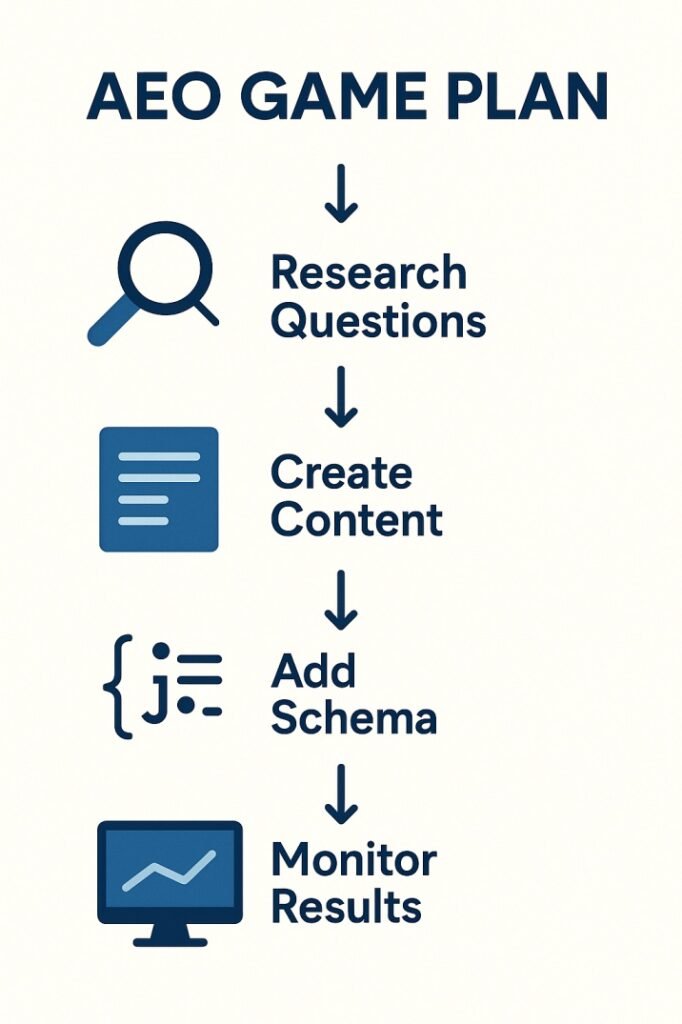
Implementation Tips for Businesses
Now that we’ve covered the strategies, let’s translate them into actionable tips you can start implementing today for Answer Engine Optimization. Especially for busy business owners, it helps to have a checklist of practical steps:
- Audit Your Existing Content: Begin by looking at your website’s current content. Identify high-value pages (product pages, top blog posts, help center articles) and see if they already answer common questions. Can you tweak headings or opening lines to make answers more direct? For example, if you have a blog post titled “All about solar panels,” consider adding a section “Q: What are the benefits of solar panels?” with a succinct answer. This could turn an ordinary paragraph into a snippet candidate.
- Create a Dedicated FAQ Section: If you don’t have one yet, build a Frequently Asked Questions page focusing on your services or products. Even 5-10 core questions to start with can make a difference. Link to it from your homepage or footer (for visibility). Not only does this help AEO, but it’s also great customer service – your users get answers quickly.
- Install Necessary Tools/Plugins: Ensure you have tools that make AEO easier:
- If on WordPress, plugins like Yoast SEO or Rank Math can help with adding FAQ schema or HowTo schema via blocks.
- If you run an e-commerce site, check if your platform supports adding schema (many do for product info which can be extended to FAQ).
- Use Google Search Console – it’s free and invaluable. It will show you the actual queries people use to reach you (maybe revealing questions you hadn’t thought of) and alert you to any structured data errors.
- Optimize Your Google Business Profile: For local businesses, this is crucial. Fill out all the sections of your Google Business Profile with correct, up-to-date info. Add an FAQ in the Q&A section of the profile as well (you can ask and answer your own questions there). Voice assistants often pull answers from here for queries like “What are [Business Name]’s hours?” or “Does [Business Name] offer [Service]?”. Consistency across directories (Yelp, Bing Places, Apple Maps, etc.) also reinforces your info.
- Use Internal Linking Thoughtfully: When you create new Q&A content, link it internally to your related pages. For instance, if you have a detailed guide on a topic and you also have an FAQ answer that touches on it, link the FAQ answer to the guide (“Learn more about this in our in-depth guide to X”). This not only helps with SEO but also signals the depth of information on your site for that topic, which can bolster your authority.
- Monitor and Adjust: After implementing changes, give search engines a few weeks to re-crawl your site. Then monitor:
- Check if those pages start showing up for their targeted question keywords (using Search Console or just Googling in incognito).
- See if you gained any featured snippets. If not, see who has them and refine your answer. Sometimes a slight wording change can do it.
- Watch site analytics – are people spending time on your FAQ page? Are they clicking through to your site after a voice query (you might see traffic from “source: direct/voice” or an uptick in direct traffic which could be from voice devices not labeling the source).
- Educate Your Team: Make sure whoever writes content for you (staff or freelancers) understands these AEO principles. A quick training or style guide listing “write at least one Q&A in each article” or “always answer the main question in the first 2 sentences” can maintain consistency. Furthermore, encourage a culture of keeping content fresh and user-focused.
- Patience and Persistence: Like traditional SEO, AEO results won’t be overnight. Don’t be discouraged if you don’t immediately get that coveted featured snippet. Keep refining and adding helpful Q&A content. Over time, you’ll likely build momentum – one answer gets picked up, then another, and so on.
By following these steps, you’re essentially baking AEO into your regular content workflow. The initial setup (especially adding schema or creating an FAQ page) might take some effort, but the long-term payback of capturing voice answers and featured snippets can be significant for your business’s visibility.
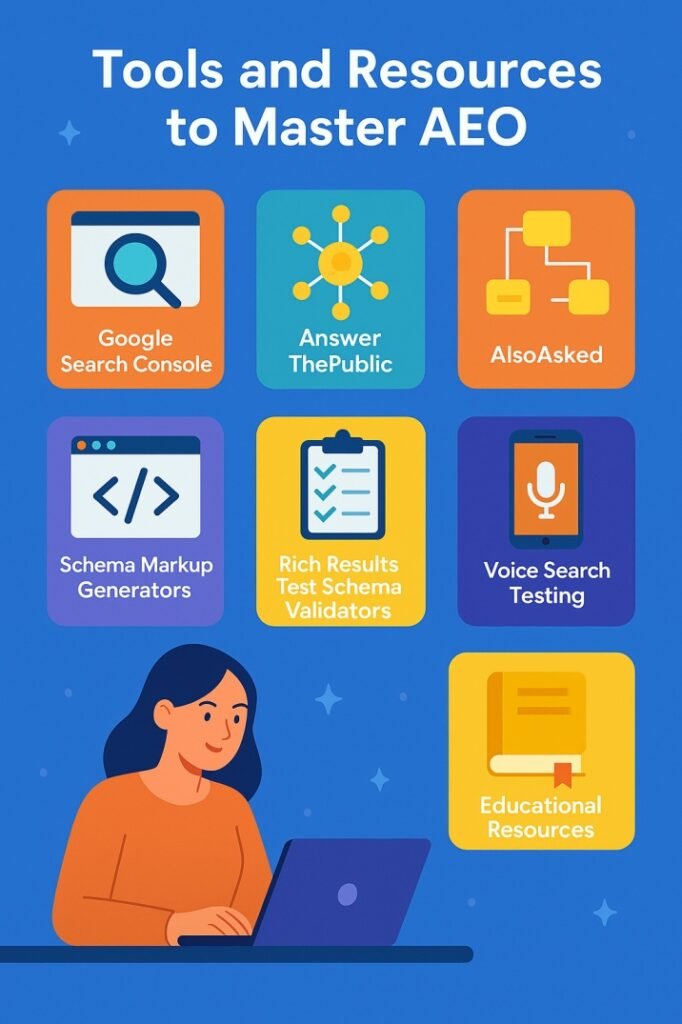
Tools and Resources to Master Answer Engine Optimization
To make your journey into Answer Engine Optimization smoother, here are some handy tools and resources. These will help you research what questions to target, implement the technical aspects, and keep track of how you’re doing. Many of these tools are user-friendly (even for non-technical users) and some are free or have free features:
- Google Search Console (GSC): Free. This is a must-have for any website owner. GSC lets you see what queries lead people to your site. It’s great for uncovering question keywords you already rank for (perhaps on page 2, which you can improve) or identifying if you’re appearing in any rich results. It also reports errors in your structured data via the Enhancements reports, so you can fix those and ensure your schema markup is correct.
- AnswerThePublic: Freemium. Enter a keyword, and it generates a visual web of common questions people ask around that keyword. It’s a quick way to get a ton of question ideas that real users are searching. For example, typing “email marketing” might show questions like “How to do email marketing?”, “Is email marketing effective in 2025?”, etc., which could guide content creation.
- AlsoAsked: Freemium. This tool specifically scrapes Google’s “People Also Ask” questions and organizes them. It helps you see related questions to a main query. For instance, for “digital marketing” it might show a branching of People Also Ask questions that you can plan to answer in your content.
- Schema Markup Generators: If you’re not using a plugin, you can use free tools like Merkle’s Schema Generator or Google’s Structured Data Markup Helper. They provide a fill-in-the-blanks interface to generate JSON-LD code for FAQs, How-tos, etc. You then paste that into your page HTML (if you have access or ask your developer to).
- Rich Results Test & Schema Validators: Google’s own Rich Results Test allows you to test a URL (or code snippet) to see which structured data is detected and if there are errors. Another is Schema.org’s validator (Validator.nu) for a more raw check. Use these after adding markup to ensure everything is correct.
- SEO Tools for Snippets: Paid SEO suites like SEMrush, Ahrefs, or Moz have features to identify featured snippet opportunities. They can show if a query has a featured snippet and who currently holds it. Some even give suggestions on how to steal (or “snatch”) that snippet by modifying your content. If you have access to these tools, it’s worth exploring their AEO/featured snippet sections.
- Voice Search Testing: There isn’t a single dominant tool for this yet, but some approaches include:
- Manually testing with devices (Google Assistant on mobile, Siri on iPhone, Alexa devices).
- Using browser-based tools like Speechify or Google’s Text-to-Speech to read out your content and see how it sounds – useful for ensuring your writing is conversational.
- Monitoring forums or using services like ReviewTrackers (for local businesses) to see if customers mention finding you via voice (e.g., someone might leave a review saying “Found this cafe through Siri and had to try it!”).
- Educational Resources: Stay up to date with guides and case studies:
- Google’s Search Central blog and Developer Guidelines: Google often publishes insights on how to get featured snippets or how their voice assistant sources answers. Following their best practices (like the E-E-A-T content guidelines and structured data documentation) is invaluable.
- Industry Blogs (SEJ, Moz, Search Engine Land): These sites frequently discuss voice search trends, featured snippet strategies, and algorithm updates. A recent Search Engine Land article, for example, highlighted how optimizing for Google’s new SGE (Search Generative Experience) is becoming part of AEO. Such insights can give you an edge.
- Community Forums: The SEO community on Reddit (r/SEO) or Q&A sites like Stack Exchange Webmasters often share experiences about what worked or didn’t for snippets and voice. Sometimes a quick browse there can save you trial-and-error time.
Leveraging the above tools and resources will not only make AEO easier, it can also accelerate your results. Moreover, using tools helps you base your decisions on data rather than hunches – you can see exactly what people ask, how search engines view your site, and where opportunities lie, making your optimization efforts much more effective.
Conclusion: Embrace AEO for Future-Proof Visibility
In conclusion, Answer Engine Optimization is more than a buzzword – it’s a natural evolution of SEO in a world where users expect immediate answers. For business owners, AEO offers a chance to own those answers and be the trusted voice that customers hear when they ask a question. By comparing AEO vs SEO, we’ve seen that it’s not about doing one or the other, but enhancing your existing SEO with an answer-focused approach. From implementing schema and crafting snippet-ready content to optimizing for voice search and maintaining high-quality info, AEO encompasses a range of best practices that all ultimately put the user’s question first.
Adopting Answer Engine Optimization strategies can lead to higher visibility on search platforms that go beyond the traditional Google results page – including voice assistants and AI-driven answer engines. This means more touchpoints where your brand can appear as a helpful answer, which in turn builds brand recognition and trust. It’s quite powerful when someone’s first interaction with your business is hearing your blog’s advice spoken by Alexa, or seeing your FAQ quoted in Google’s answer box.
Now is the time to take action. The search landscape in 2025 and beyond is leaning heavily toward answers and AI. Don’t wait for competitors to corner the answer market in your niche. Start by applying the tips in this guide: identify burning questions, update your content, add those technical tweaks, and polish your answers. Over the coming weeks, monitor how your content is performing and keep refining it.
Ultimately, business success comes from being helpful and visible to your customers. AEO is a strategy that delivers both – helpfulness (by providing direct answers) and visibility (by placing you where those answers are sought). Embrace Answer Engine Optimization today, and ensure that when your customers ask, you are the one who answers.
Ready to put Answer Engine Optimization into practice and boost your business’s online presence? Contact our team for a personalized content audit or download our AEO checklist to start optimizing your content for direct answers. Don’t miss out on the next wave of search – let’s optimize your content for the answer-driven future and make sure your business is the one that customers hear loud and clear!